
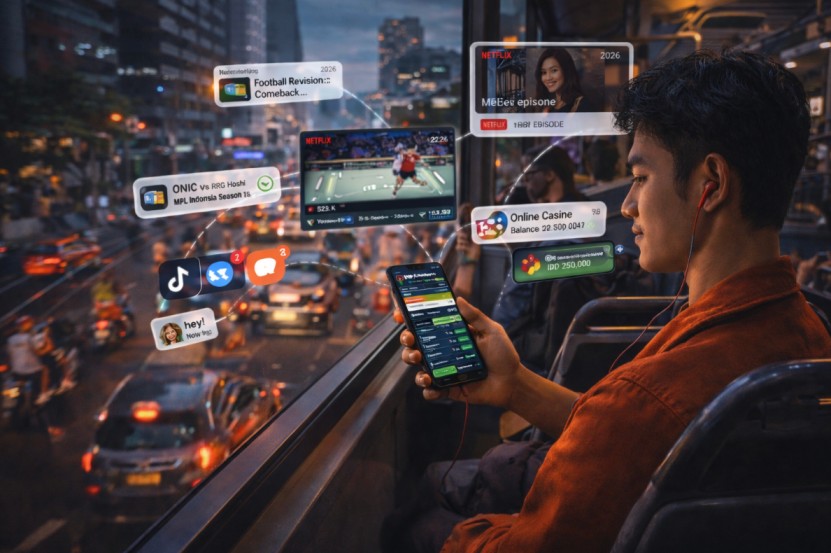
Indonesia’s online sports culture in 2026 runs on the same device that handles chat, streaming, payments, and late-night arguments. DataReportal says the country had 331 million mobile connections, 230 million internet users, and 180 million social media user identities by late 2025, while We Are Social reports that social networks remained the most visited type of site or app, with chat and messaging platforms close behind. That explains why a football qualifier, a badminton final, and a Mobile Legends playoff do not stay inside their official broadcasts for long; each moves almost immediately into reposts, short clips, screenshots, and supporter threads. Fans do not wait.
Before kickoff, the argument had already started
The Indonesia-Bahrain match on March 25, 2025, still reads as a good map of how this works. ESPN lists the venue as Gelora Bung Karno, the attendance at 69,599, and the 1-0 result sealed by Ole Romeny in the 24th minute, but the digital afterlife came from what happened around the goal: Marselino Ferdinan’s final pass, Bahrain’s narrow line, and the timing of the run were all being cut into clips and debated before halftime. In that same mobile sequence, MelBet registration fits neatly beside lineup graphics, live-score apps, and supporter forums because fans already moving between predicted elevens, pressure phases, and match probabilities tend to want a short route into a platform without leaving the live discussion. One small observation from that night still holds up: the goal was replayed not as a single finish, but as a chain of spacing errors and one clean attacking movement that looked clearer on the second and third viewings than it did in real time.
Badminton learned to speak in numbers
Badminton communities in Indonesia now read matches with almost the same hunger for data as football communities do. The official BWF report says 20-year-old Alwi Farhan beat Panitchaphon Teeraratsakul 21-5, 21-12 in the Indonesia Masters 2026 final, and the tournament page confirms the event ran from January 20 to 25 at Istora Senayan with a USD 500,000 purse. That sort of scoreline does not remain inside celebration for long; it becomes a thread about point runs, ranking consequences, and whether the match was decided at the net before the second game settled. Another small observation is easy to spot in Indonesian badminton spaces now: official scoring, draw position, and ranking math have become part of the entertainment rather than background material for specialists.
The middle of the night belongs to short sessions
Sports communities have also changed the way adjacent digital entertainment is used. Once a supporter is already shifting between a replay clip, a BWF results page, a WhatsApp group, and a creator’s reaction stream, an online casino session no longer arrives as a separate evening plan; it joins the same short-cycle habit as a quick bracket check or a return to live stats. That overlap matters because Indonesian users increasingly reward products that reopen fast, show fresh numbers immediately, and let the session continue after interruption rather than forcing a restart. The thread keeps going.
Esports tightened the loop
MPL Indonesia Season 15 showed how far the habit has moved toward constant, shared watching. Esports Charts says the tournament reached 4,132,224 peak viewers and generated 113,297,084 hours watched, while Moonton confirmed that ONIC beat RRQ Hoshi in the grand final on June 15, 2025. Those are not just scale numbers; they describe a culture in which a draft screen, a jungle rotation, and a late team fight become raw material for clip accounts, Discord debates, and instant verdicts while the series is still live. A third small observation now feels standard across Indonesian esports communities: the argument starts before the result, because viewers are already isolating one pick, one failed retreat, or one objective trade before the desk has even finished its recap.
Borders on the map matter less on the screen
Indonesian fans no longer compare sports platforms only against domestic habits. They compare refresh speed, live-stat layers, match-center design, and mobile usability across Southeast Asia, and MelBet Malaysia sits inside that wider comparison when users move from Indonesian football talk to regional products that package scores, data, and interactive features in different ways. The important shift is not simply brand visibility, but the way cross-border exposure has raised expectations for everyone: if a score refresh lands late, if a stat layer feels thin, or if a page interrupts the flow of discussion, the audience notices immediately because the benchmark now comes from the whole region rather than one market. Online sports culture in Indonesia has become comparative by instinct, and that has made design, speed, and live context part of the argument alongside the match itself.
After the whistle, the culture keeps moving
That is what shapes digital sports culture in Indonesia in 2026: not merely access to streams, but the constant recirculation of moments by users who annotate, rank, argue, and republish in real time. Football supplies the loudest pulse, badminton sharpens the appetite for numbers, and esports accelerates the loop, while forums, social platforms, and dedicated match pages turn user-generated material into a parallel record of the event. The result is a sports culture that lives in highlights, data cards, and shared interpretation as much as in the match itself. The final whistle still matters, but it rarely ends the conversation anymore.